Overview
PetroPyQAPF is a Python desktop application for reproducible igneous rock classification and technical reporting. Its architecture separates the formal modal decision from geochemical contrast, probabilistic support, interpretive synthesis, mineral-atlas reference, petrographic image review, and report presentation.
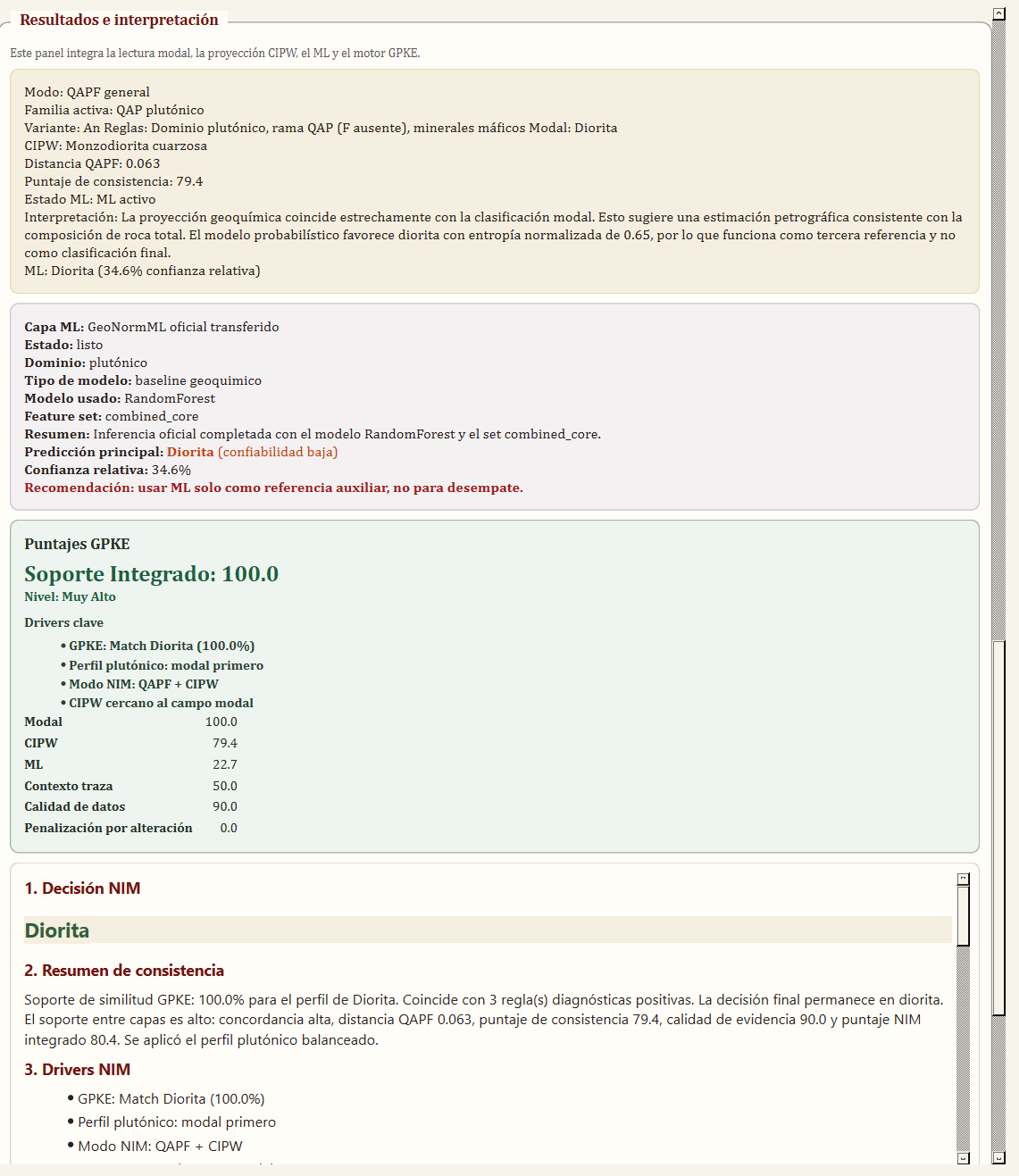
The central rule remains explicit: formal classification is modal and petrographic whenever that evidence applies. CIPW, ML, the Normalized Interpretation Model (NIM), the Geological Petrological Knowledge Engine (GPKE), assisted interpretation, and image tools provide context, contrast, or review support; they do not automatically replace petrographic judgment.
Current Capabilities
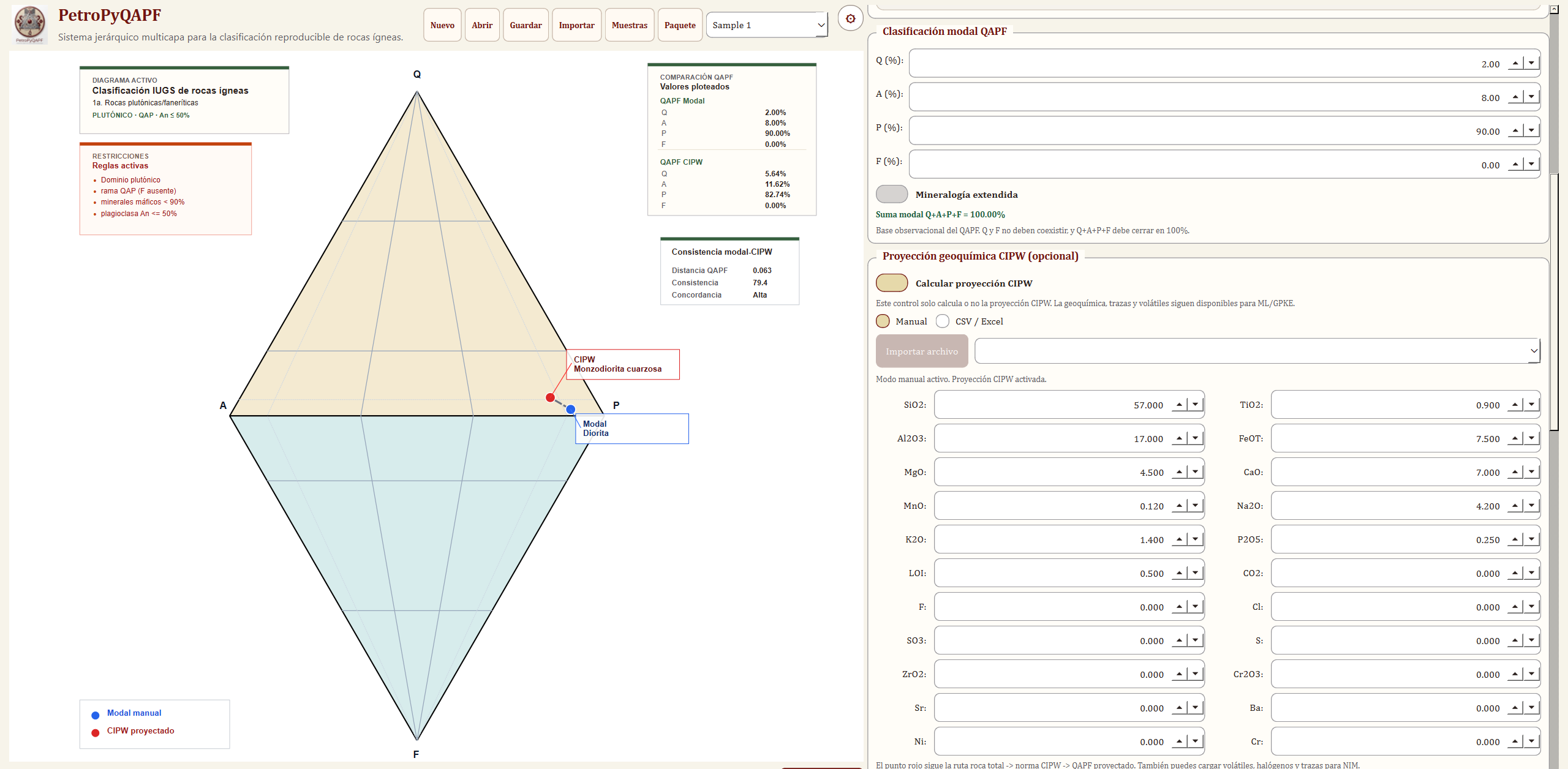
- IUGS-QAPF modal classification for plutonic and volcanic domains
- Specialized routing for gabbroic, ultramafic, plutonic, and volcanic branches
- Validation of modal components, petrographic auxiliaries, and major oxides
- CIPW normative projection through GeoNormPy
- Modal versus CIPW comparison with distance, consistency, and warning signals
- Official domain ML models: XGBoost for VOL (volcanic rocks) and RandomForest for PLU (plutonic rocks)
- Normalized Interpretation Model (NIM) synthesis for support, uncertainty, evidence factors, and review recommendations
- GPKE and hypothesis layers as part of the extended reasoning workflow
- User-configured AI-assisted interpretation through local Ollama, OpenAI API, or Anthropic API services
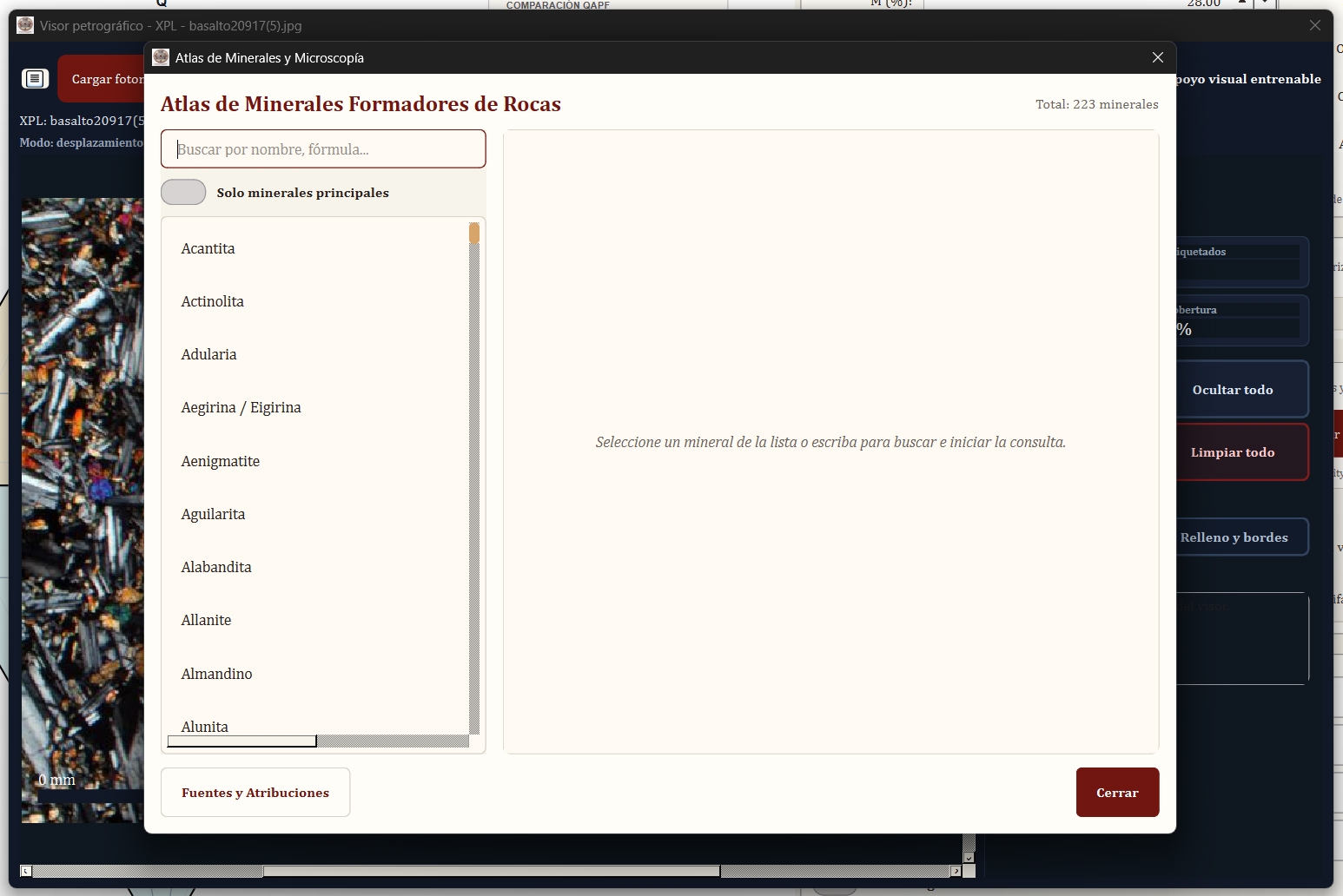
- Bilingual mineral atlas for rock-forming minerals
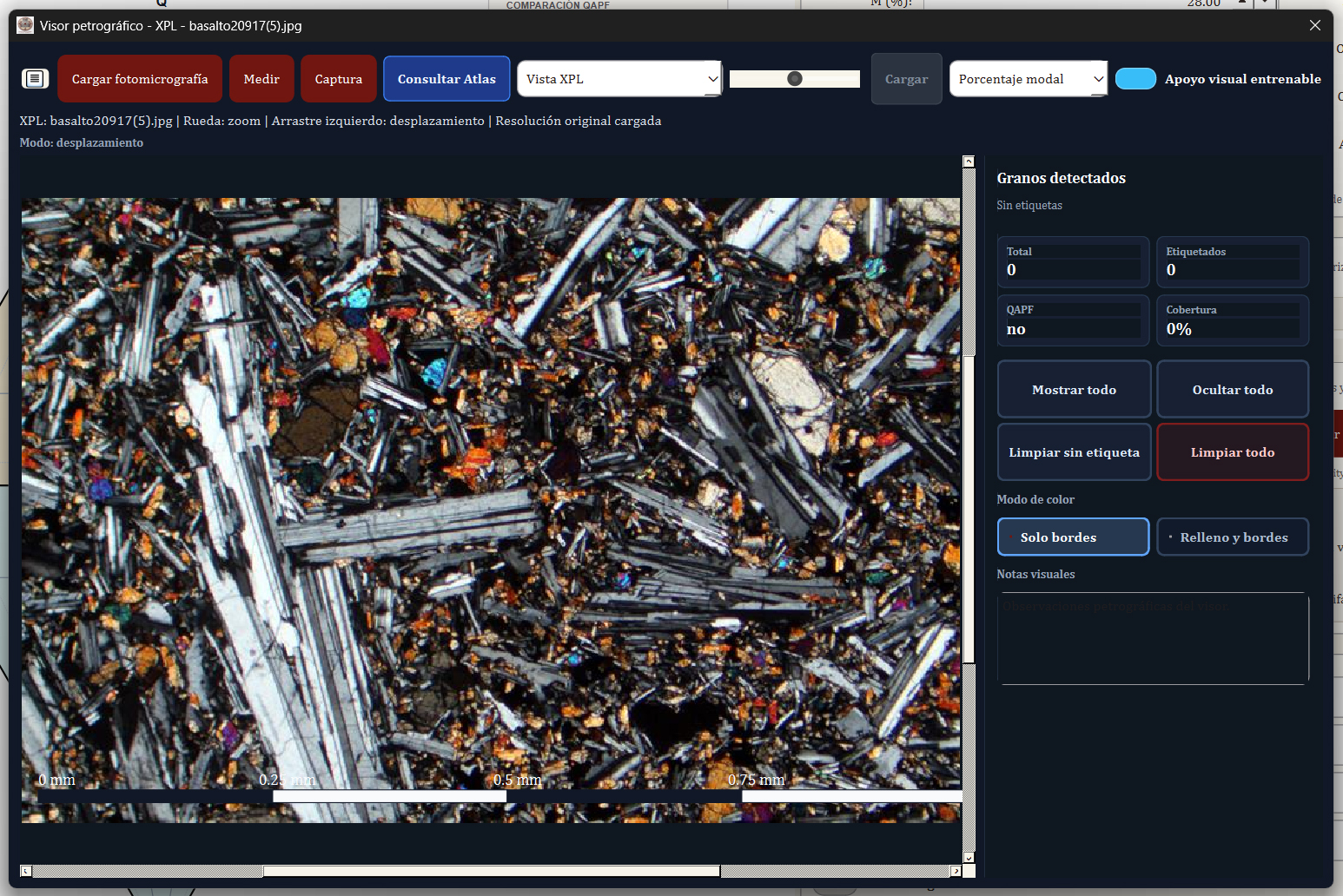
- Experimental petrographic viewer for PPL and XPL photomicrographs
- JSON, text, DOCX-template, and PDF report outputs
- Optional Google/Firebase desktop authorization
- Spanish and English interface selection with persisted configuration
Project Workspace
PetroPyQAPF now supports multi-sample project work rather than only isolated single-sample runs. The workspace includes batch import from CSV or Excel, a compact sample selector, session autosave, recovery after unexpected closure, unsaved-change indication, and a custom GisGeo project format with the .gisgeo extension.
Project packages can be exported as ZIP files with summaries, reports, associated images, and viewer captures when available.
Petrographic Viewer
The petrographic viewer supports PPL and XPL image loading, view-type selection during import, visual comparison with a movable vertical or horizontal divider, zoom, pan, position adjustment, user-proposed diameter calibration, measurement marks, annotations, and report-ready captures.
This layer is designed for documentation and visual review. It remains experimental and does not replace modal classification.
Mineral Atlas
The integrated atlas covers rock-forming minerals through a local bilingual knowledge base. It supports search by name and formula, cards with descriptions, properties, notes, and visual references, and displays content according to the active application language.
Academic Release
PetroPyQAPF is published as an academic release for students, teaching activities, and non-profit research that need a reproducible support tool for igneous petrology, review, and documentation.
Direct download route: Download PetroPyQAPF
Academic registration route: Register for academic use
Licensing & Access
PetroPyQAPF provides free academic access for students, teaching activities, and academic or independent research conducted strictly without profit.
Enterprise licensing, consulting, private integration, institutional use, government use, commercial processing, or any for-profit use requires prior written authorization through jordanzav@gisgeo.dev.
The official website is the only authorized source for obtaining the software. Redistribution, repackaging, third-party hosting, reverse engineering, decompilation, or modification of the executable and its authentication or access-control systems is not authorized without written consent.
Privacy & Data Handling
PetroPyQAPF works as a local desktop application. Scientific data, petrographic images, reports, and generated results remain under the user’s responsibility and local control.
The software does not perform intrusive collection, storage, or transmission of analytical data to external servers unless the user explicitly configures their own backend or an external service.
Google/Firebase authentication is used only to verify whether the user’s email is authorized to run the application. This verification does not transmit samples, chemical compositions, petrographic images, or generated reports.
AI-assisted interpretation is optional and depends on services configured by the user, including local Ollama or the user’s own OpenAI or Anthropic API credentials. The user remains responsible for deciding what information is sent to any external AI provider.
Current Status
As of June 6, 2026, the system integrates the core classification flow, project workspace, mineral atlas, petrographic viewer, bilingual interface, report export, and packaging support.
The next maturity stage is focused on manual QA of the GUI, login, language switching, manual and file-based workflows, PDF export, complete Nuitka packaging on a clean machine, and external scientific validation with curated samples and expert comparison.
Current Limits
- Image inference and petrographic-image support remain experimental
- The viewer documents observation but does not replace modal classification
- CIPW, ML, the Normalized Interpretation Model (NIM), GPKE, and assisted interpretation are support layers, not substitutes for petrographic judgment
- Full external scientific validation is still pending